Picture courtesy: Wikipedia
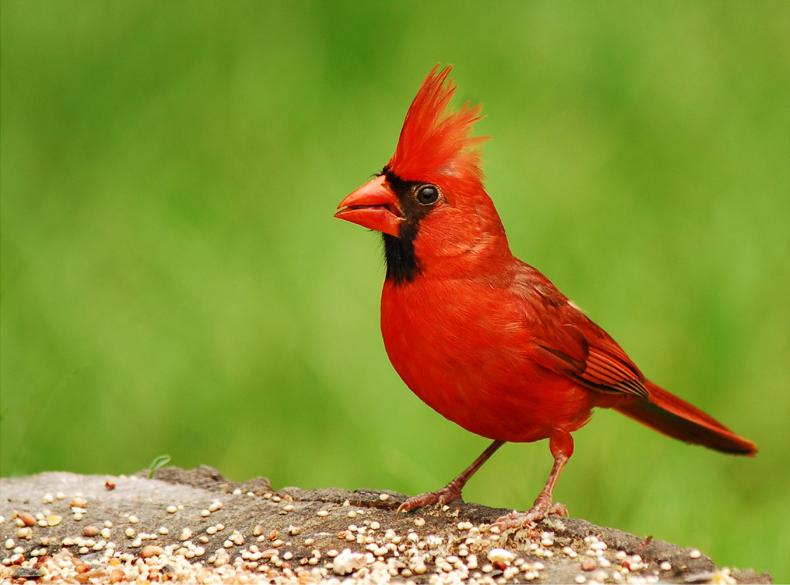
My window overlooks a thicket and a couple of sprouting bushes. And every morning, the bushes receive a visit from a particular cardinal. He pecks at the spring sprouts, brushes his beak on the slender branches, and call out as he hops between the bushes. It is tempting to set up a bird seed cage and entice him to spend more time in my yard. My training as a field ecologist makes me think this strategy may be good in some ways.
We have been taught not to feed wild animals. This is particularly important for mammals. If there is ever a need to feed them, it is best to leave them only natural foods. Similarly for birds, it is best not to feed birds with bread or rice or other cooked items that are meant for human consumption. We can however offer the birds some seeds. Bird seeds are available in all grocery and pet stores around the country. This opens up other opportunities. You could also join a team of observers and become a citizen scientist!
Project Feeder Watch, invites everyone to take part in conservation of birds. To join, all you need to have is a bird feeder and your green space or backyard. There is a simple application process. You also get training to enable you to participate fully in this program. This is a popular program with more than 25,000 participants.
Visit the website to enroll in the project if you are interested. It is simple, fun, and exciting to be a part of the network providing data directly to the scientists. All you need to do is to fill your bird seed feed, identify the birds that come to feed and keep a list. Share the list of bird visitors to your bird seed feeder with the scientists. Continue watching the antics of the birds and lookout for new species of birds that visit your feeder. Visitors can vary through out the year.
In case, you wonder what good could come out of feeding birds and your observations, here is an example. Scientists noted that the data from Florida feed watchers showed a decline in the winter population of the Painted Bunting since the 1980s. This was not the only source of data scientists used to arrive at the conclusion. They has also collected data about the population of breeding birds. That data too showed a decrease in population by 4% every year.
In simple math, if there were 100 Painted Bunting pairs when scientists began to track the population, the next breeding season, the were down to 96 pairs. In 10-years only 60 breeding pairs would be left. Very soon, if the population of birds were not closely monitored, and support provided for the population, the species could become extinct locally. The data provided by people has helped scientists find some population trends.
The species diversity and abundance of birds are indicators of the habitat they live in. As humans develop the land for building roads, homes, farming, plantations, dams or other purposes, we also destroy the habitats for wild birds and animals. The development also leaves us with less natural spaces and wildlife to interact with. Taking a moment to enjoy the wildlife in our own backyard provides us with context for understanding larger ecological implications to our actions while connecting with nature in unexpected ways.
Put out your bird feeder today!